Meeting with the management of the Pomeranian Voivodeship Office’s Department for Foreigners — outcomes of 10 October
Queues, digitalisation and court proceedings: what we discussed with the Director on 10 October and what we are bringing to the meeting in early November.
On 10 October 2026, representatives of Tu Żyjemy met with the Director of the Department for Foreigners at the Pomeranian Voivodeship Office. The discussion lasted around an hour and a half. We talked about how applications are processed, IT systems, court proceedings and further joint work to improve the residence legalisation process.
The office’s workload
According to the Director, the office’s general email address receives around 1,600 messages a day: documents, additions to case files, enquiries and other correspondence.
At the time of the meeting, the office was sending around 720 requests a week for documents needed to assess the merits of an application — wezwania do uzupełnienia braków merytorycznych.
What happens after fingerprints are taken
The Director explained that repeatedly sending documents after fingerprinting, but before receiving a request for documents at the substantive assessment stage, does not move a case forward in the queue. Formal reminders, known as ponaglenia, do not change its position in the office’s internal queue either.
When an applicant receives a wezwanie do uzupełnienia braków merytorycznych, the case is already being assessed on its merits, in a separate queue. Submitting the requested documents does not send it back to the general queue of cases awaiting assessment.
At this stage, applicants need to provide a complete, up-to-date set of documents from the list they receive. According to the Director, once all the requested documents have been submitted, a decision should follow relatively quickly — approximately within a month. This was an estimate given at the meeting, not a guaranteed deadline for every case.
A separate question concerns significant changes in circumstances, such as the grounds for residence. At the meeting in early November, we will clarify what to do in these situations: when to report changes and how to submit the documents.
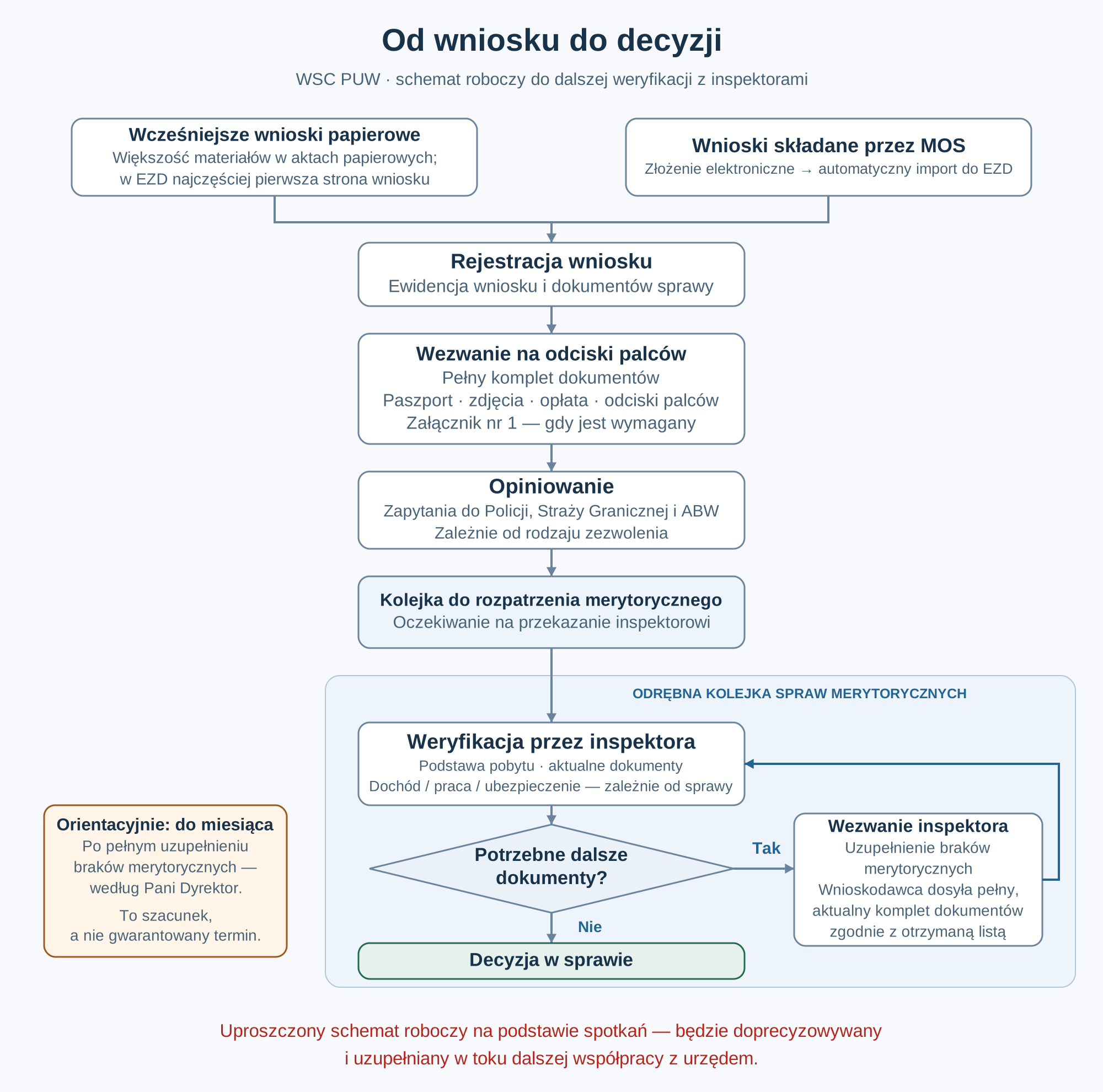
From application to decision.
How the IT systems work
The discussion helped us understand where case materials are kept and how staff work with them. Submitting an application electronically does not yet mean that all subsequent work on the case is handled digitally.
EZD is used to register and process correspondence and to store electronic documents and scanned case materials, including applications, ZUS certificates, PIT tax returns and other documents.
According to the Director, applications are already being imported automatically from MOS into EZD. How effectively this works in practice will become clearer once those cases start being assessed.
Applications submitted through MOS are also printed, and paper case files are created from them.
For applications submitted before MOS was introduced, most case materials are kept on paper. EZD contains only some of the documents, so a record or individual files in the system do not mean that the case officer has a complete electronic copy of the case file.
Storing documents is only part of the work. Case officers also need to see the stage an application has reached and check information about the foreign national. Other systems are used for this, and we discussed them at the meeting too.
Cudzoziemcy is one of the Pomeranian Voivodeship Office’s main systems. Staff use it to work on cases and view their status; its development is organised by the Pomeranian Voivodeship Office. It is linked to EZD and POBYT through the case number. The extent of integration and the degree to which data exchange is automated still need to be clarified.
POBYT is a national system that brings together information about foreign nationals, including visas, current grounds for residence, checks carried out by the Border Guard (Straż Graniczna) and other general information. It is accessible to authorised staff of the relevant authorities, including staff at the voivodeship office.
Data from applications submitted through MOS must also reach Cudzoziemcy and POBYT. We still need to establish whether the data is imported automatically or entered manually.
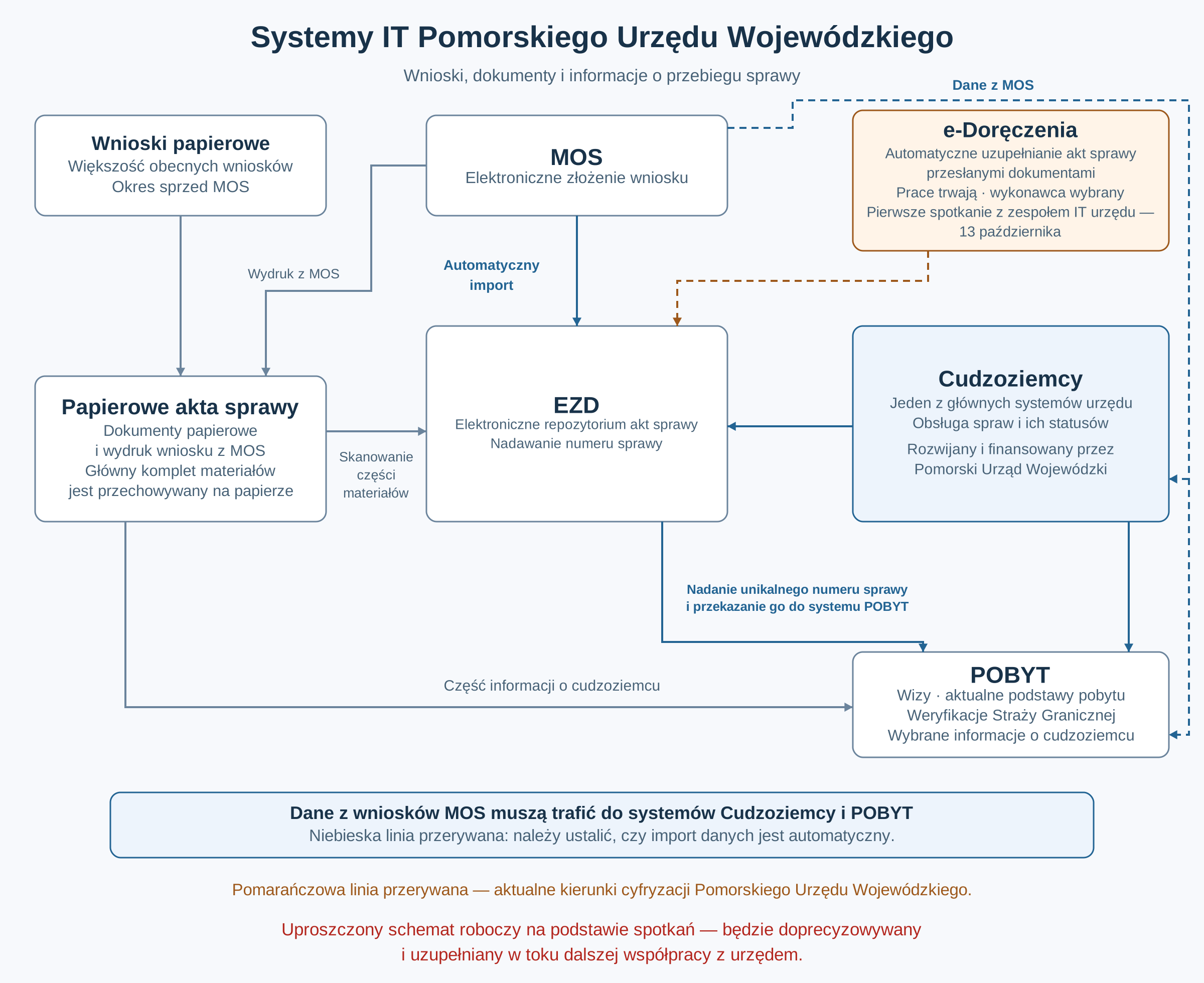
The Pomeranian Voivodeship Office’s IT systems.
Changes under discussion
According to the Director, the Ministry of the Interior and Administration (MSWiA) wants assessment of applications submitted through MOS to begin. Starting work on some of these cases is under consideration. This approach had not yet been introduced at the time of the meeting. We will share details of the timing and arrangements for any changes as soon as we learn more.
A meeting between office representatives and the contractor upgrading Cudzoziemcy is scheduled for 13 October. The tasks under discussion include improving document exchange between Cudzoziemcy and EZD and making up-to-date case materials available to help case officers work faster.
CUKR and staff allocation
The Director noted that few people are applying for CUKR and that this procedure is not yet widely used.
At the next meeting, we will propose discussing whether some staff working on CUKR could be assigned to other cases.
According to the explanations we received, the additional posts concerned are funded through FAMI, the Asylum, Migration and Integration Fund, and are tied to specific project tasks. We will therefore clarify what changes to the funding conditions and what approvals would be needed to reallocate this work. For now, this is our proposal for discussion.
Paper files and sending case materials to court
We discussed how sending a case file to court affects further work on the case.
The Director explained that original case materials are sent to the court. As older files are predominantly on paper, only some documents remain in the electronic systems.
Previously, copies, including scans, were made before files were sent, but this practice was later discontinued. The Director attributed this to the time required for copying and scanning amid a growing workload: according to her account, around a year and a half ago there were only a fifth as many court proceedings concerning delays.
As a result, case officers often do not have a complete electronic copy of a paper file sent to court. This was how the Director explained the organisational side of the problem.
An additional reason for cassation appeals
Alongside the reasons we have discussed before, the Director mentioned another: the possibility of reducing the amounts ultimately paid to applicants.
We also checked this against court decisions stored in our database. The sample reviewed on 10 October comprised 48 cases against the Pomeranian Voivode in which the Voivodeship Administrative Court in Gdańsk (WSA) had awarded a sum of money to the claimant and a subsequent decision by the Supreme Administrative Court (NSA) was available:
- in 18 cases, the monetary award was set aside;
- in 30 cases, the award was upheld;
- we found no cases in this sample where the award was reduced to a lower but non-zero amount.
Setting aside the monetary award did not always mean setting aside the obligation to examine the application. For example, in case II OSK 349/26PL, the NSA set aside the monetary award but upheld the obligation to examine the application within 30 days, as imposed by the WSA judgmentPL.
Continuing work on the app
As we reported earlier, we have begun working with the administration on the concept for an app that will help people identify and prepare the documents they need for their individual circumstances.
At this meeting, we discussed the next step: whether applications prepared through the app with a complete, up-to-date set of documents could proceed straight to assessment on the merits. This could reduce repeated requests for documents and the waiting time during which documents become outdated.
The Director reviewed the proposed process and expressed a willingness to see a presentation of the app and assess whether this way of working could be introduced — without making any commitment to introduce it at this stage.
We were also told at the meeting that MSWiA is awaiting the results of our work. We hope this experience will help build effective cooperation between the administration and residents of the Pomeranian Voivodeship.
Cooperation and the meeting in early November
The Director noted that specialists with the relevant skills could consider participating in public procurement procedures. We offered to help the contractor carrying out the current upgrade with the office’s digitalisation, free of charge. The Director said she would pass our offer on to the contractor. It is not yet known whether the contractor will accept our help.
A working meeting lasting several hours is scheduled for early November with the management and case officers of the Pomeranian Voivodeship Office’s Department for Foreigners. The main topics will be the requirements for the app and a detailed discussion of how cases move through each stage within the office.
We will also prepare other proposals based on what we have learned. In particular, we want to understand what prevents coordinated assessment of applications from an entire family and what changes could help avoid children receiving their residence cards much later than their parents.
The diagrams we have prepared reflect our current understanding of the office’s work. They are simplified working diagrams based on our meetings, and we will refine and expand them as our cooperation with the office continues.